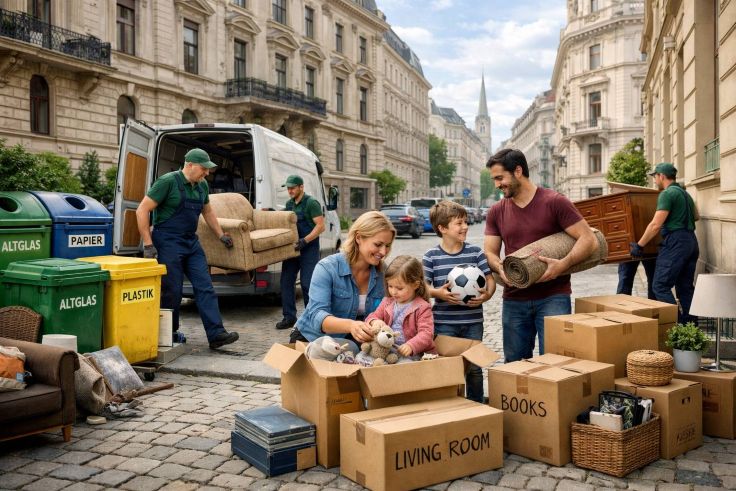
Statistics Austria reports that residential mobility remains a regular part of life for many households, with people relocating for work, family, education, or housing needs. While moving can represent a positive life change, it is also widely recognized as one of the more stressful personal experiences due to the volume of planning, organization, and decision-making involved. For residents navigating residential transitions, tasks such as packing, sorting possessions, and arranging eviction and disposal in Vienna often add significant pressure to already demanding timelines. Businesses like Objektraeumung, a clearance company that provides services like eviction and disposal (Räumung und Entsorgung Wien) often provides relief.
Vienna continues to attract residents because of its high quality of life, efficient public services, and strong housing market. Yet moving within the city can present practical challenges. Apartment buildings may have limited storage areas, parking restrictions can complicate moving logistics, and many households accumulate years of belongings that must be evaluated before relocation. These circumstances can transform what appears to be a straightforward move into a lengthy and emotionally demanding process.
Understanding the sources of relocation stress and identifying effective solutions can help residents approach moves more efficiently while supporting environmental sustainability and personal well-being.
The Growing Challenge of Household Relocation
Moving involves much more than transporting furniture from one address to another. Research published by the American Psychological Association has highlighted how major life transitions often increase stress levels due to uncertainty, time pressure, and disruption of daily routines.
For many Vienna residents, relocation begins with sorting through years of accumulated possessions. Closets, basements, storage units, and spare rooms frequently contain items that are no longer needed but have never been properly disposed of. Before packing can even begin, households often face decisions about what to keep, donate, recycle, sell, or discard.
This process can become particularly challenging when families are downsizing, moving after a bereavement, or vacating inherited properties. Emotional attachments to belongings frequently make decision-making slower and more difficult.
Common Stressors During a Move
Several factors contribute to relocation-related pressure.
Tight Timelines
Lease agreements, property sales, and employment changes often create fixed moving deadlines. Residents may have only a few weeks to organize, pack, clean, and relocate an entire household.
Data from housing experts and relocation professionals consistently shows that insufficient preparation time is one of the leading causes of moving-related stress.
Excess Household Items
Many people underestimate the amount of belongings they own. Storage spaces tend to accumulate unused furniture, broken appliances, old electronics, clothing, and miscellaneous household items over time.
When moving day approaches, these items suddenly become obstacles that require attention. Determining how to responsibly manage unwanted possessions can consume considerable time and energy.
Physical Demands
Lifting heavy furniture, carrying boxes, dismantling equipment, and transporting items between locations can be physically exhausting. Older adults, busy professionals, and families with young children may find these demands especially challenging.
Emotional Fatigue
Residential moves often involve significant emotional transitions. Leaving a long-term home, handling inherited belongings, or preparing a family property for sale can create feelings of sadness, nostalgia, or anxiety.
Experts note that emotional decision-making frequently slows progress and increases overall stress levels during relocation.
The Problem of Unwanted Belongings
One of the most overlooked aspects of moving is dealing with unwanted possessions.
Furniture that no longer fits a new apartment, outdated electronics, damaged household goods, and accumulated clutter must all be addressed before relocation is complete.
Improper disposal creates additional concerns. Vienna has established waste management and recycling systems designed to encourage responsible environmental practices. The city places considerable emphasis on waste reduction and resource recovery.
Information from the City of Vienna Waste Management Department (MA 48) indicates that recycling and proper waste separation play an important role in the city’s sustainability initiatives. Residents are encouraged to dispose of materials through appropriate channels whenever possible.
However, sorting, transporting, and disposing of large quantities of items can be difficult for individuals already managing a move.
How Property Clearance Services Help Bridge the Gap
This is where professional property clearance services often provide practical support.
Rather than treating unwanted belongings as a separate problem, clearance professionals integrate removal, sorting, and disposal into the broader relocation process.
The goal is not simply emptying a property. Instead, the service helps create an organized transition from one residence to another.
Reducing Administrative Burden
Managing a move involves coordinating multiple responsibilities simultaneously. Residents may need to update addresses, arrange utility transfers, organize transportation, communicate with landlords, and oversee cleaning requirements.
Property clearances help reduce the number of tasks individuals must personally manage by handling large-scale removal and disposal activities.
Supporting Efficient Decluttering
Decluttering before packing offers several advantages.
- Fewer items require transportation.
- Packing becomes more organized.
- Moving costs may be reduced.
- New homes remain less cluttered.
- Storage requirements may decrease.
By removing unnecessary belongings before relocation, households can focus attention on possessions they genuinely intend to keep.
Facilitating Responsible Disposal
Environmental sustainability remains a growing priority throughout Vienna.
Research from the European Environment Agency emphasizes the importance of reuse, recycling, and waste reduction as key components of sustainable urban development.
Professional clearance operations frequently sort materials for recycling, donation, or responsible disposal where appropriate. This approach supports broader environmental objectives while reducing the workload placed on residents.
Mental Well-Being and Organized Transitions
The connection between physical clutter and mental well-being has attracted increasing attention from researchers.
Studies published by institutions including the University of California, Los Angeles (UCLA) have suggested that excessive household clutter can contribute to feelings of stress and reduced psychological comfort.
During a move, clutter-related stress may become even more pronounced because every item demands attention and decision-making.
Creating a more organized environment before relocation can help individuals feel more in control of the process. Reducing visual clutter, simplifying possessions, and establishing clear priorities often make transitions feel more manageable.
For households dealing with inherited properties, estate clearances, or long-term residences, this structured approach may be especially valuable.
Supporting Sustainable Urban Living in Vienna
Property clearances also connect to larger sustainability goals within Vienna.
The city has long been recognized for environmental planning, resource efficiency, and waste management initiatives. Responsible handling of unwanted household goods helps support these efforts by reducing landfill use and encouraging material recovery whenever possible.
When reusable items are redirected through donation channels or recycling systems, fewer resources are wasted. This contributes to a more circular approach to consumption while helping residents manage relocations more effectively.
As urban populations grow and housing needs evolve, efficient management of household belongings becomes increasingly important for both residents and cities.
RELATED ARTICLE: Why Attic Clearance in Vienna Can Improve Mental Well-Being
Conclusion
Moving house in Vienna involves far more than transporting possessions from one location to another. Tight deadlines, accumulated belongings, physical demands, and emotional attachments can quickly transform relocation into a stressful experience.
Professional property clearance services help bridge this gap by addressing one of the most time-consuming aspects of moving: the management of unwanted items. Through organized removal, responsible disposal practices, and support for recycling and reuse, these services can reduce administrative burdens and simplify residential transitions.
For many households, the result is a more manageable move, reduced mental strain, and a smoother path toward settling into a new home. At the same time, responsible clearance and disposal practices align with Vienna’s broader commitment to sustainability, resource conservation, and environmentally conscious urban living.