Working high above the ground among tree branches requires far more than physical strength. For professional arborists, safety depends on a combination of technical skill, mental discipline, and sustained focus. While tools like chainsaw bars and chains are essential for cutting through dense branches efficiently, their safe use ultimately relies on the operator’s state of mind.
These tools are powerful and effective, but they demand constant awareness. A momentary lapse in attention can lead to serious consequences. Despite this, the connection between mental readiness and safe equipment use is often overlooked. In reality, it plays a critical role in preventing accidents and ensuring successful tree maintenance.
Psychological Demands of Climbing Tree
Professional tree climbing is very different from recreational climbing. Arborists often work at significant heights while carrying equipment and stabilizing themselves on uneven or flexible branches. This environment requires a high level of psychological preparedness.
Remaining calm under pressure is essential. Arborists must make quick, accurate decisions about branch stability, rope positioning, and cutting angles. These decisions directly affect both their safety and the quality of their work.
Several mental skills are particularly important in this field:
- Sustained attention and concentration
- Risk awareness and evaluation
- Emotional control in high-risk situations
- Effective decision-making under pressure
When these abilities are combined with reliable climbing gear and well-maintained equipment, arborists are better equipped to handle complex and potentially dangerous tasks.
Understanding Chainsaw Bars and Chains
Chainsaw bars and chains are among the most critical tools in arboriculture. They determine how efficiently a chainsaw cuts and how stable the cutting process remains. The guide bar directs the cutting path, while the chain’s sharp teeth perform the actual cutting.
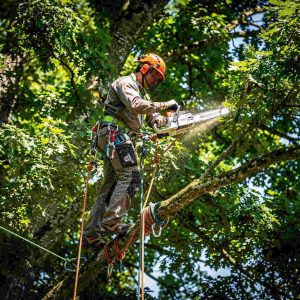
For arborists working in the tree canopy, proper maintenance of these components is essential. Well-maintained chainsaw bars and chains offer several advantages:
- Faster and more efficient cutting
- Reduced risk of kickback
- Greater control during branch removal
- Less material waste during trimming
On the other hand, worn or poorly maintained chains can increase both physical strain and mental stress. When tools are difficult to control, arborists must divide their attention between managing the equipment and completing the task. High-quality, well-maintained tools help reduce this burden, allowing workers to focus on precision and safety.
Mental Strength and Skill Mastery
Arboriculture is a demanding profession that naturally builds mental resilience. Working in challenging and unpredictable environments encourages the development of patience, focus, and problem-solving skills.
Over time, arborists learn to trust both their training and their equipment. This trust is crucial; it allows them to remain composed and efficient even in high-pressure situations. The balance between physical capability and mental awareness becomes the foundation of both safety and performance.
The Role of Mindset in Safety
In high-focus professions like arboriculture, mindset plays a significant role in determining outcomes. A strong mental state enhances awareness, improves reaction time, and supports better decision-making.
Understanding how the mind responds to stress and risk can provide valuable insights not only for arborists but for other industries as well. Prioritizing mental readiness is just as important as maintaining physical tools, as both directly influence productivity and safety.
Conclusion
Tree maintenance is a complex task that requires a careful balance of technical expertise, physical ability, and mental focus. As arborists navigate tree canopies, they rely on specialized tools and climbing gear to perform precise and often hazardous work.
Equipment such as chainsaw bars and chains enables efficient cutting and better control, especially in challenging conditions. However, even the best tools cannot guarantee safety on their own. True effectiveness comes from combining reliable equipment with strong mental discipline and situational awareness.
Ultimately, the most successful arborists understand that safety is not just about having the right tools; it also depends on having a focused, prepared, and resilient mind.